Opinion
I suspect it is asking for too much to expect Reform to act honourably and drop the racism
Martin Shipton
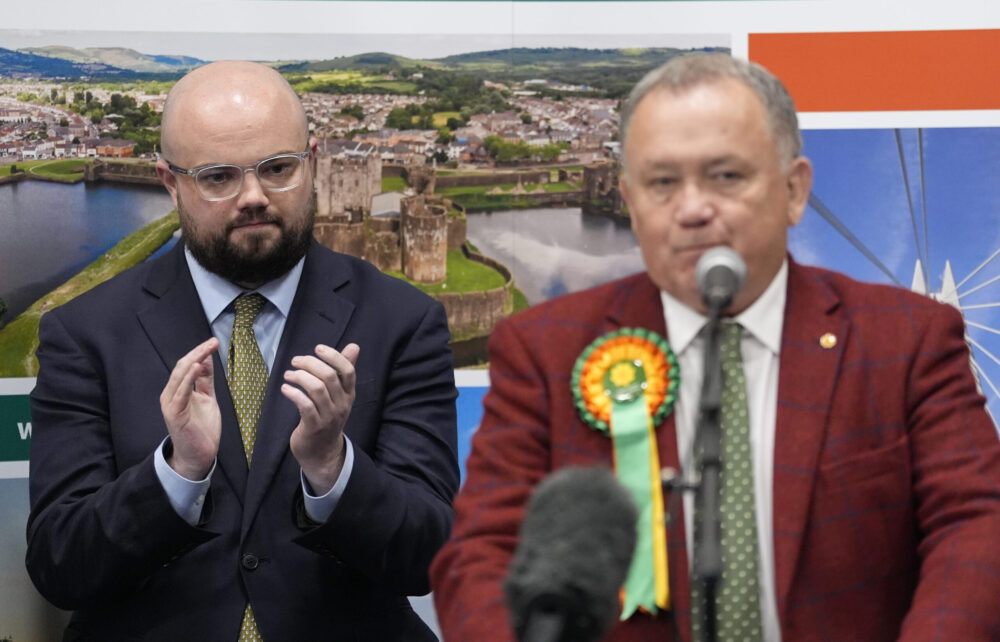
Plaid Cymru MS Mabon ap Gwynfor highlighted on X a telling incident that occurred in Caerphilly Leisure Centre immediately after the declaration of the result of the Senedd by-election.
Lindsay Whittle, Plaid’s victorious candidate, was standing on his own when he was approached by BBC Wales political reporter Teleri Glyn Jones, who said to him: “We’ve grabbed you as the winner of this, but the rest of the room’s media is going for the person who’s come second, Llyr Powell from Reform. What do you think that tells us?”
Whittle, for once slightly flustered, replied: “I simply don’t know.”
Ap Gwynfor’s comment was pertinent: “It tells us that for the rest of the UK, Wales continues to be misunderstood and overlooked. It also immediately repeats the failures that contributed to this thumping victory and shows how the UK establishment hasn’t learnt anything.”
[mid-content-banner]
Farage obsession
There’s a more specific point to be made too. The UK media’s obsession with Nigel Farage and Reform UK has acted as a recruiting sergeant for the party in the same way as the depiction of Farage in the run-up to the Brexit referendum in 2016 as a genial extrovert with whom it would be great to have a pint was pivotal in securing victory for the Leave vote.
Treating politicians as celebrities - even a very temporary one like Reform’s Caerphilly candidate Llyr Powell - is not healthy and creates an unserious tone that militates against the discussion of serious issues.
We had it for years with Boris Johnson and look where that led.
It’s quite clear from the way they behaved during the by-election campaign that Reform thought they could take Caerphilly by breezing into the constituency, patronising the locals and offering those in the right place at the right time the exciting opportunity to take selfies of themselves with Farage.
Some people jumped at the chance, but on the basis of the election result, significantly more chose to opt out and went further, considering how best to use their vote to ensure Farage’s minion wasn’t elected.
[lower-mid-content-banner]
Lacking in confidence
I’ve known Llyr Powell for quite a few years, mainly in his capacity as a press officer for the succession of parties that Farage has led. He’s always seemed to me very different from the typically cocksure and arrogant UKIP / Brexit Party / Reform type. More suitable words to describe him would include awkward, lacking in confidence, vulnerable and prone to tetchiness when things aren’t going his way. All these traits were on display to one degree or another during the by-election campaign, and they weren’t to the advantage of his candidacy. It’s been suggested that if he had been elected to the Senedd, Farage would have made him the leader of the Reform Cymru brand, but maybe that is off the table for now.
For obvious reasons Farage has been reluctant to name a leader of the party in Wales (we need to remember that he’s the majority shareholder of Reform 2025 Ltd, a private company, not a conventional political party - so no democracy).
The party has been built up as a personality cult around Farage himself. No one else has his allure with the electorate, and in advance of next May’s Senedd election, he, as the decision maker, has a dilemma. Does he appoint as leader in Wales an individual who may be loyal to him, but who fails on the charisma front, or does he seek to present himself as the party leader in Wales, even though he represents a seat in Essex and won’t be a candidate for the Senedd?
Leader's debates
If it’s the latter, the broadcasters should think long and hard before allowing Farage to participate in leaders’ debates and interviews on behalf of the party’s Welsh branch during the course of the election campaign. My view is that it ought not to be permitted.
It would also be appropriate, from a democratic point of view, for journalists covering the Senedd election - especially those from UK-wide news outlets - to familiarise themselves with the intricacies of Welsh politics and not view it through an Anglocentric prism. Regrettable as many of us may find it, Reform is likely to play a significant role in the election campaign, but coverage of that party’s prospects should not be out of kilter with that of other parties’. Hopefully Plaid Cymru’s victory in Caerphilly should have brought that home.
With the introduction of a new, wholly proportional electoral system, it would be great if the parties would commit to focussing their campaigns on the major policy issues for which the Welsh Government is responsible.
Reform sought to turn the Caerphilly by-election into a referendum on the Welsh Government’s Nation of Sanctuary policy. It was a disgraceful strategy, partly designed to divert attention from the fact that Reform has no policies of note that are specific to Wales, but also to seek votes by misrepresenting what the programme was about and stirring up racial hatred.
I suspect it is asking for too much to expect Reform to act honourably and drop the racism, because they wouldn’t have much left on offer without it. But other parties need to call them out at every opportunity.
Scare stories
With Plaid Cymru having momentum after Caerphilly, it’s inevitable that their opponents will engage in scare stories about the cost of Welsh independence. Labour will do it - even though polling shows that around half their supporters back the notion of an independent Wales - and the perennial ranter Andrew RT Davies will never tire of referring to Plaid as “separatist nationalists”.
But while a cost benefit analysis of the merits of independence has academic interest, it has no relevance in the context of the coming Senedd election. Rhun ap Iorwerth has made it clear that a Plaid government would not seek to hold a referendum on Welsh independence in its first term. And in any case, any decision on the matter would be made by referendum, not by a vote in the Senedd. Again, it’s fanciful to believe that Labour and Mr Davies will restrain themselves on this issue too.
Topics that are legitimate for debate, in my view, include the relationship between the Welsh and UK governments, and whether it works to Wales’ advantage, and the success or otherwise of Reform’s performance in the string of local authorities it controls in England.
My final plea is that parties should not make spurious use of opinion poll findings to persuade voters to back them. Labour made fools of themselves by trying to peddle the line that the Caerphilly by-election was a tight fight between themselves and Reform, and that Plaid Cymru had no chance of winning. They pushed this line in leaflets, on social media and on giant hoardings. They knew it was a lie when they commissioned the material, but refused to own up until after the polling stations had closed, when they admitted they had known for a significant time that they had no chance of winning.
We’ve a busy time ahead. Wouldn’t it be great if all parties committed to running campaigns devoid of toxicity?
Support our Nation today
For the price of a cup of coffee a month you can help us create an independent, not-for-profit, national news service for the people of Wales, by the people of Wales.
Get more trusted Welsh news
Choose Nation.Cymru as a preferred source in Google News to see more of our journalism.